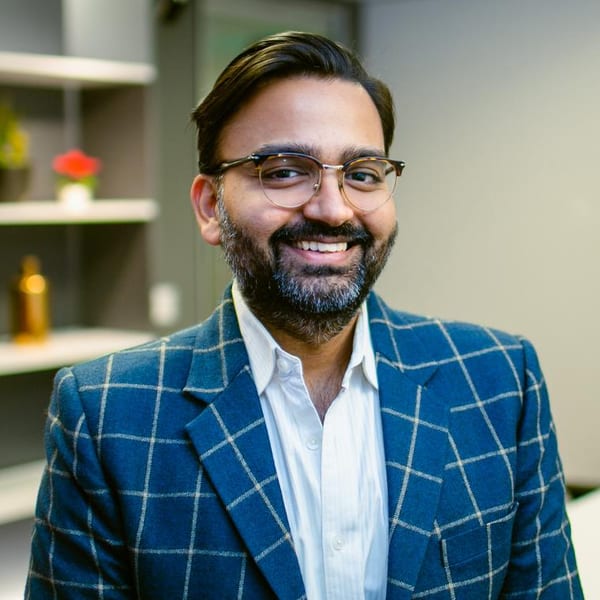
How I got here
I started in investment banking in 2008, at Credit Suisse in India, on healthcare and retail. In early 2011 I moved to Credit Suisse's Technology Investment Banking practice in San Francisco. Six months in, Marc Andreessen published Why Software Is Eating the World. Something clicked: software was still early, but I wanted in. The next six years were spent learning how software companies actually work — from the outside, in deal rooms — across $20B+ of M&A and IPOs: Proofpoint, Twilio, Emptoris–IBM, hybris–SAP, Infor–GT Nexus, Fieldglass–SAP, the Epiq Systems sale, and the Vormetric sale to Thales. The shape of software businesses got into my bones.
I left Credit Suisse in 2016, did a brief stint at UBS, and in late 2017 moved back to India to build the global software practice at Avendus Capital. It was a remarkable moment to be in that seat — Indian SaaS was finding the global market, and companies like Zenoti, Innovaccer, Postman, Freshworks, Chargebee, MoEngage, and Whatfix were defining what that looked like.
One of the companies I'd been working with at Avendus was Zenoti — vertical SaaS for beauty and wellness. In late 2019 I joined them as the first finance leader, and over the next two years we raised $240 million across three rounds and built the company through unicorn status. COVID was the real test: instead of layoffs or salary cuts, we built 325 bespoke customer relief offers and held net revenue retention above 94%. At Zenoti, the CFO role was never just finance — I owned strategy, fundraising and investor relations, corporate development, business operations, and the M&A scoping that led to two acquisitions and a strategic deal with Regis.
In 2021 I left to build my own thing. Krayo was meant to be the operating system for corporate spend — buy, pay, manage — for the office of the CFO. I sketched every screen and flow by hand, recruited a fifteen-person team, shipped two product modules, and got to revenue while bootstrapping. It didn't scale into the company I wanted it to be, and after three years I wound it down. I learned more about product, GTM, and my own limits in those three years than in any other stretch.
After Krayo I joined Hive — vertical SaaS for live event marketing — and led the CFO function from 2024 through 2025. I built the three-year strategy and the path to profitability, kept ARR growth above 60%, captured $1.5 million in vendor savings, launched the company's first formal performance review cycle, and put a data-driven decision engine in place.
Across both the banking and operating years, I've hired, mentored, and developed a lot of people. The bankers I trained in San Francisco and Mumbai are now operational leaders at tech companies or hold senior roles at investment funds; many of the operators I managed have moved on to bigger seats. Being a small part of those arcs is some of the work I'm proudest of.
What else do I do
I host Strategy of Finance, a podcast and publication about the disciplines of finance — pricing, capital allocation, the modern finance function, M&A, IPO readiness, the things that orbit the CFO seat. 31 episodes and counting, with guests from CFOs and founders to pricing experts and board directors. The essays sit alongside the conversations.
I angel invest in early-stage SaaS, AI, and FinTech — ten-plus checks, follow-ons in five, one exit (Tripeur to Navan).
I advise founders on the things finance touches and the things it doesn't but should — fundraising, GTM, organization design, the conversations that are hard to have. I also work with finance and other professionals on career moves and salary negotiations, which is more of a craft than most people realize.
The thing I'm spending the most time on right now is AI — what it changes for finance work specifically, where it actually earns its keep, and how to think about it past the noise.
Themes I keep returning to
A few ideas keep showing up across the writing and the conversations. Finance as a craft, not a function — judgment, taste, and the hard conversations that don't appear in any model. The discipline of capital allocation in companies that have to choose. Pricing as the most leveraged decision most teams underweight. And the line between linear growth — put X in, expect Y out, give or take — and the non-linear bets that take years to compound but never start if you don't begin them.
Where I came from
I grew up in Sikar, a small town in Rajasthan, in a large Marwari joint family with the family business and a generous supply of chartered accountants among the cousins. The path was paved; I didn't want to walk it. The MBA was the first real divergence. Then Mumbai for the early career, San Francisco for the seven years that rewired how I think, and back home. Each move was a chance to pick the harder, less linear path — to choose problems where the answer wasn't obvious, and to build something rather than inherit it.
Elsewhere
- Strategy of Finance — podcast and essays · subscribe to How to Win
- LinkedIn — linkedin.com/in/rohitagarwal001
- Email — rohit@strategyoffinance.com