How to evaluate finance software
A vendor-neutral framework for choosing finance tools — five foundational pillars, and three traits that decide whether your team actually uses them.
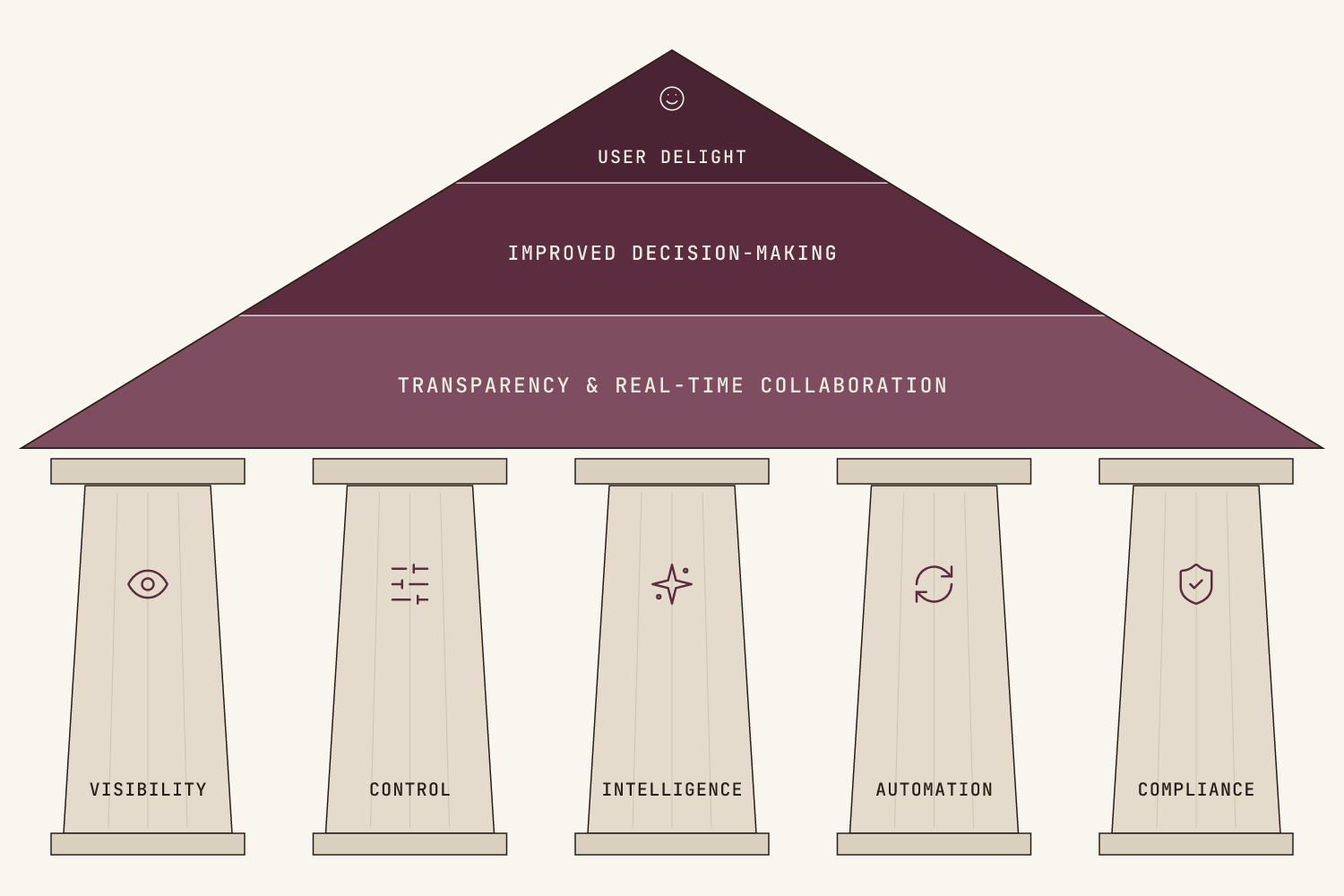
The finance function has never had more software thrown at it. Every category — close, FP&A, spend, treasury, billing — has a dozen well-funded tools each promising to be indispensable, and the modern CFO is expected to assemble a stack that drives growth and decisions, not just records them. The hard part isn’t finding options. It’s choosing well among them.
What’s usually missing is a consistent lens — a way to judge any finance tool on the same terms, so you compare substance instead of demos. Here’s the one I use. It has two halves: five foundational pillars, the hard capabilities a tool must have, and three behavioral traits that decide whether your team actually adopts it. Hard skills and soft skills, if you like. A tool can ace the first five and still fail the last three — and you’ll have bought expensive shelfware.
The five foundational pillars
These are the table stakes — the capabilities that get a tool onto the shortlist.
Visibility
A clear, ideally real-time view of your financial and operational data. As businesses get more complex and faster-moving, stale month-end snapshots stop being enough. The best tools surface balances, transactions, and the journeys behind them as they happen — so decisions run on current reality, not last month’s.
Control
The ability to manage workflows, approvals, and authorizations — and to set budgets and track against them — so that activity (e.g. spending) is governed proactively rather than explained after the fact. Every action should be compliant and auditable by default, not reconstructed at quarter-end. This matters far more now that software can act on its own: once a tool runs agents, control means deciding what they may do without a human, capping their limits, and logging every action they take.
Intelligence
This is where the ground has shifted most. In 2023, “intelligence” meant analytics — finding patterns, flagging anomalies, surfacing recommendations. Today the best tools embed copilots you can query in plain language, and increasingly agents that carry out multi-step work rather than just suggesting it. The value was never “has AI” on the box; it’s whether the intelligence genuinely reduces your team’s judgment load — anticipating problems, handling the high-volume, repetitive activity by exception — and whether you can see and trust how it got there.
Automation
Time is the scarcest resource in finance. Good software takes the repetitive work — data entry, reconciliation, reporting, payment outflows — off your team’s plate, which both frees them for strategic work and removes a major source of error. The frontier now is agents that handle whole multi-step workflows end to end, not just discrete tasks. Judge automation by how much real effort — and how much judgment — it can safely shoulder, not by how many features it lists.
Compliance
The regulatory burden only grows, and it compounds as you operate across more geographies. A serious finance tool helps you track and manage compliance obligations and stands up in an audit — rather than becoming one more thing to reconcile by hand.
The three traits that decide adoption
Five pillars get a tool onto the shortlist. These three decide whether anyone is still using it six months later.
Transparency and real-time collaboration
Finance increasingly works off a shared pane of glass with sales, marketing, product, and ops. The tools that stick let everyone collaborate on the same numbers — which kills the “whose data is right?” arguments and builds the cross-functional trust that good decisions depend on.
Decision support
A modern finance tool should be action-oriented: harnessing data to support, and ideally recommend, a decision — not just presenting a tidy dashboard. The test is simple. Does it move you closer to a call, or just give you more to interpret?
User experience
Business users are consumers too, and they judge work software against the apps they use at home. A finance tool that’s genuinely pleasant and efficient gets adopted; one that isn’t gets worked around, however powerful it is. Delight isn’t a luxury here — it’s what determines whether the other seven qualities ever get used at all.
When the software starts acting
Until recently, finance tools mostly informed; now they increasingly act. Agents can reconcile an account, chase a collection, draft the variance commentary, or tee up a payment — with a human approving rather than doing. That shift makes this framework matter more, not less.
It also changes where the weight sits. Intelligence and automation get far more powerful — and control and compliance become the safeguards that keep that power usable: what an agent may do, within what limits, with what audit trail, and where a human stays in the loop. The finance leader’s job moves from doing the work to setting the guardrails and owning the judgment. Evaluate a modern tool for how well it lets you do exactly that.
Putting it to work
Run any finance tool through these eight, and the comparison stops being about who gave the best demo. The first five tell you whether the software can do the job — and, increasingly, whether you can trust it to do that job on its own. The last three tell you whether your team will work alongside it. Buy for both, and the tool earns its place in the stack — driving growth and better decisions, instead of gathering dust in the budget.
Related questions
- How should a CFO evaluate finance software?
- Judge every tool on the same eight criteria so you compare substance, not demos. Five are foundational capabilities — visibility, control, intelligence, automation, and compliance. The other three decide adoption — transparency and real-time collaboration, decision support, and user experience. The first five tell you whether the software can do the job; the last three tell you whether your team will actually use it.
- What should you look for when buying finance software?
- Real-time visibility into financial and operational data; proactive control over workflows, approvals, and budgets; intelligence that anticipates problems rather than just reporting them; automation that removes genuine manual effort; and compliance that stands up in an audit. Then check that it's collaborative, action-oriented, and pleasant enough to use that the team adopts it.
- Why do finance tools fail to get adopted?
- Because buyers evaluate capabilities and ignore behavior. A tool can have every feature and still gather dust if it isn't collaborative, doesn't move users closer to a decision, or is unpleasant to use. Adoption is decided by transparency, decision support, and user experience — not by the length of the feature list.
- How should you evaluate AI and agents in finance software?
- Look past the 'has AI' label. The questions that matter: does the intelligence reduce your team's judgment load or just add another dashboard; can agents safely take multi-step work end to end; and can you govern what they do — capping their limits, keeping a full audit trail, and keeping a human in the loop where it counts. As software shifts from informing to acting, control and compliance become the safeguards on that autonomy.
Updates
- Extracted as a standalone framework, made vendor-neutral, and updated for the agent era — copilots, autonomous agents, and the controls they demand.