Almost no one can charge for outcomes
Outcome-based pricing is the most-hyped end state in AI software — and the most sealed-off. The barrier isn't ambition. It's measurement.
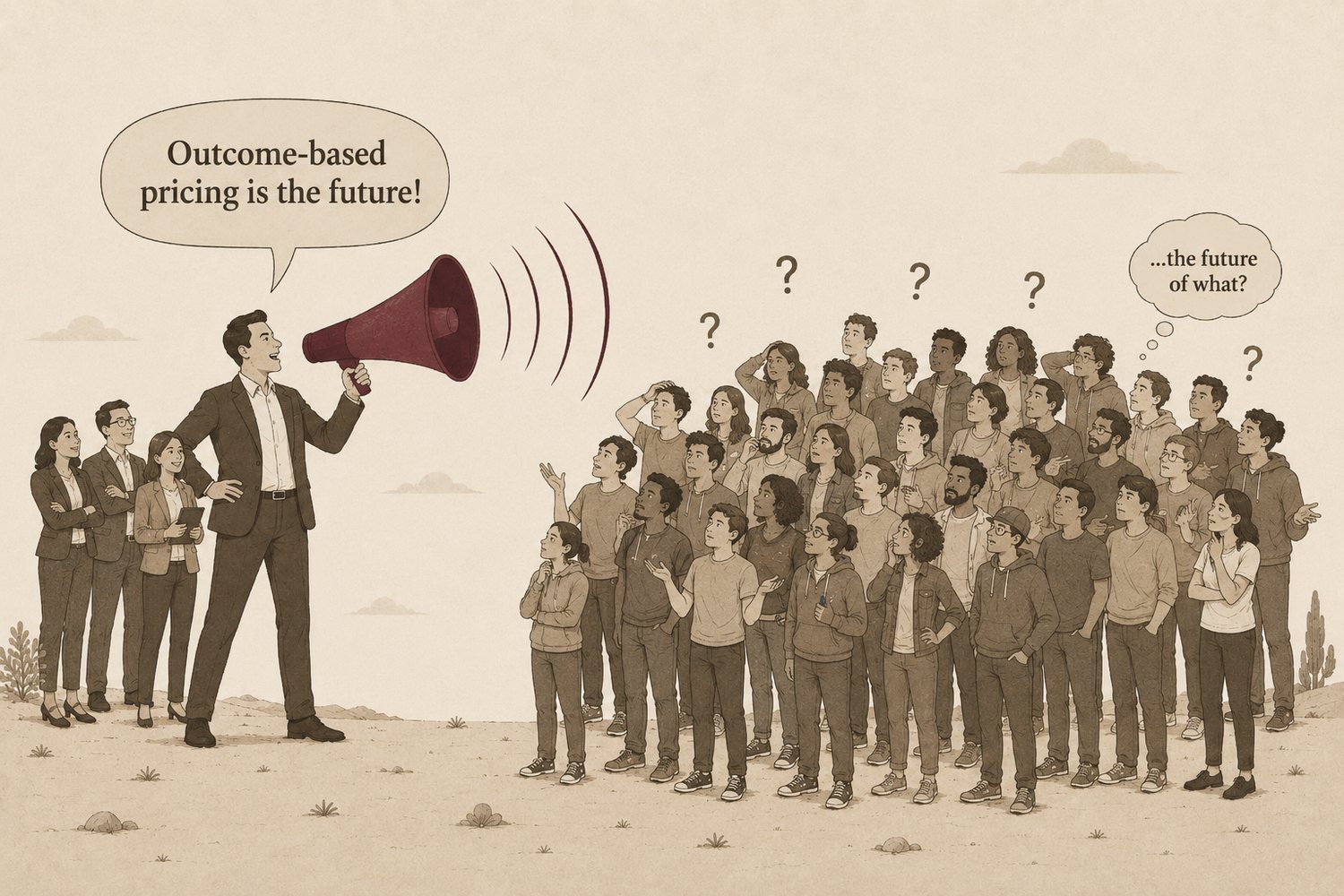
Sit through enough AI strategy talks and you'll hear the same prophecy: software is done charging for access, the future is charging for results. You won't buy a tool; you'll buy resolved tickets, closed deals, finished work. It's a lovely story, and the data from 52 AI pricing pages says it is almost entirely not happening. Of every product in the AI Credit Index, only two charge purely for outcomes — and both were born doing it. Not one walked there from a subscription. The frontier everyone is marching toward turns out to be sealed.
That gap — between how much outcome pricing gets talked about and how little of it exists — is the most strategically useful finding in the whole study. Because the reason it’s sealed isn’t a lack of ambition. It’s a constraint, and the constraint tells you exactly where the rare opportunities are.
The frontier, by the numbers
Lay the 52 products on the continuum from access-priced to usage-priced (the full map is the pillar essay), and the right edge is nearly empty. The mass — 35 products — sits at a hard credit allotment. A dozen more bill metered overage. At the very end, the pure-consumption frontier holds just three products, and only two of those charge per delivered outcome rather than per action.
Then the detail that turns a small number into a thesis: inbound migration to the frontier is zero. Every product that prices on outcomes today started there. Intercom’s Fin support agent launched in 2023 at $0.99 per resolved conversation and has held that model ever since — broadening it in 2026 to charge per qualified sales lead, but never abandoning the per-result core. Zendesk’s resolution-priced agent, the same. Not one seat-based incumbent and not one credit-metered startup crossed over into outcome pricing in the eighteen months I tracked. The frontier is populated by birthright, not by journey.
The barrier is measurement, and it’s permanent
Why can’t products walk to the frontier? Because to charge for an outcome you must do two things, and most AI work fails at least one of them: you must define the outcome — get both sides to agree on what counts as the result — and you must attribute it — show the product produced it, not the human or the other system in the loop. AI makes attribution acute, because AI work is almost always co-produced.
“A resolved support conversation” clears both bars. There’s a discrete event, both parties can see it, the system logs it, and you can refund cleanly when it doesn’t occur. “A qualified lead” clears them too — matched, routed, observable. These are the categories where outcome pricing lives, and it’s not a coincidence that they’re the same ones: support and sales produce countable, attributable results.
Now try it on the rest of the panel. What’s the billable outcome of a coding assistant — a merged pull request? Whose? The model wrote a third of it and the engineer rewrote the rest. What’s the outcome of an image generator — a “good” image? A presentation tool — a “persuasive” deck? These outputs are real and valuable, but the value is entangled with the user’s own judgment and effort, which makes the result impossible to define cleanly or attribute fairly. You cannot bill per outcome when neither side can agree on what the outcome was. So those products meter the action instead — the generation, the request, the run — because the action is the only thing that’s cleanly countable. That’s not a failure of imagination. It’s the measurement constraint doing its work.
And it’s permanent, not transitional. Better models won’t make a slide’s persuasiveness objectively measurable. The categories where outcomes are legible were legible before AI; the ones where they aren’t won’t become so. The frontier stays the address of the few, structurally.
The cautionary tale: when you reach and miss
The most instructive product on this question isn’t one of the frontier residents. It’s the one that tried to reach the frontier and had to retreat — Salesforce Agentforce.
Agentforce launched at the end of 2024 charging $2 per conversation — an outcome-flavored, results-adjacent unit, exactly the model the prophecy calls for. The traction was real but modest for a company its size — on the order of eight thousand deals against a 150,000-plus customer base — and the priced unit itself drew steady friction. A “conversation” was coarse and ambiguous: it could branch, linger, or go nowhere, which made spend hard to forecast and, by many customer accounts, only loosely connected to the value actually delivered. So Salesforce reworked the model — to Flex Credits at roughly $0.10 per action in May 2025, and later per-seat licensing alongside it — a deliberate walk down from an outcome-flavored unit to per-action metering.
Read that carefully, because it’s the thesis in miniature: the most resourced software company on earth reached for a coarse outcome unit, couldn’t make it stick, and retreated to charging for actions. If Salesforce can’t force an outcome model onto a product whose outcome isn’t cleanly measurable, the lesson for everyone smaller is loud. You don’t choose outcome pricing. Your product’s measurability chooses it for you.
What this means for where to build
This is, at heart, a where-to-play finding, and it cuts two ways for anyone building.
If your product happens to sit in a category with a legible outcome — a countable, attributable, provable result — then outcome pricing isn’t just available to you, it’s a moat. It’s the one rung of the continuum almost no competitor can climb to, because they’d have to be born there. Price on the result, guarantee it, and you’ve aligned your revenue with customer value in a way a credit allotment never can. That alignment is the thing pricing strategists prize most — a price as a clean signal of value delivered, the idea Jean-Manuel Izaret built our whole conversation around. If you can charge for outcomes, you almost always should.
But if your value is real and diffuse — mixed into the user’s own work, impossible to isolate as a discrete result — then chasing outcome pricing is a trap. You’ll invite disputes (“the AI didn’t actually resolve that”), adverse selection (customers who only pay when results are cheap to produce), and an eventual retreat to per-action, the Agentforce path. The honest move is to build the best metered business on the rung you can actually occupy — and to know that the rung is set by your measurability, not your ambition. Most AI products, by the math of the Index, will live on the hard allotment, and there’s no shame and a lot of margin in running that well.
So the prophecy isn’t wrong, exactly. It’s just badly distributed. Outcome pricing is the future — for the handful of categories that were always going to get there, and were. For everyone else, the whole game is being honest about which rung you’re on. The map of who sits where, archived product by product, is the AI Credit Index — and the right edge of it is the most valuable real estate in software precisely because so few can ever move in.
Related questions
- What is outcome-based pricing?
- Charging for a delivered result rather than for access, seats, or usage. Instead of paying a subscription or a per-action credit, the customer pays only when the product produces a defined outcome — a resolved support ticket, a qualified sales lead, a completed job — and pays nothing when it doesn't. Intercom's Fin agent is the canonical example: $0.99 per resolved conversation, with no charge if it fails to resolve. It's the purest alignment of price with value, and the hardest to implement, because it requires an outcome both sides can measure and agree on.
- Why is outcome-based pricing so rare in AI software?
- Because most AI work has no outcome you can both define and prove. Pricing per result requires a clean, observable, attributable event — and 'a resolved ticket' qualifies while 'a better-designed slide' or 'a faster codebase' does not. Of 52 products in the AI Credit Index, only two price purely on outcomes, both in categories (support, sales) where the result is legible. And tellingly, every one of them launched that way — none migrated to it from a seat or credit model. The frontier is reached by being born on it, not by walking to it.
- Should my startup use outcome-based pricing?
- Only if your product produces an outcome you can define precisely, observe automatically, and defend when a customer disputes it. If it does, outcome pricing is a genuine moat — it's the rung almost no competitor can climb to. If it doesn't — if your value is real but diffuse, mixed with the user's own judgment — forcing an outcome model invites disputes and adverse selection, and you'll likely retreat to per-action or a credit allotment, as Salesforce did with Agentforce. The honest first question isn't 'how do we charge for outcomes?' but 'is our outcome measurable enough to bill?'