AI pricing is just COGS finally showing up
For twenty years software had no cost of goods sold worth mentioning. Inference ended that — and the credit meter is what it looks like on the invoice.
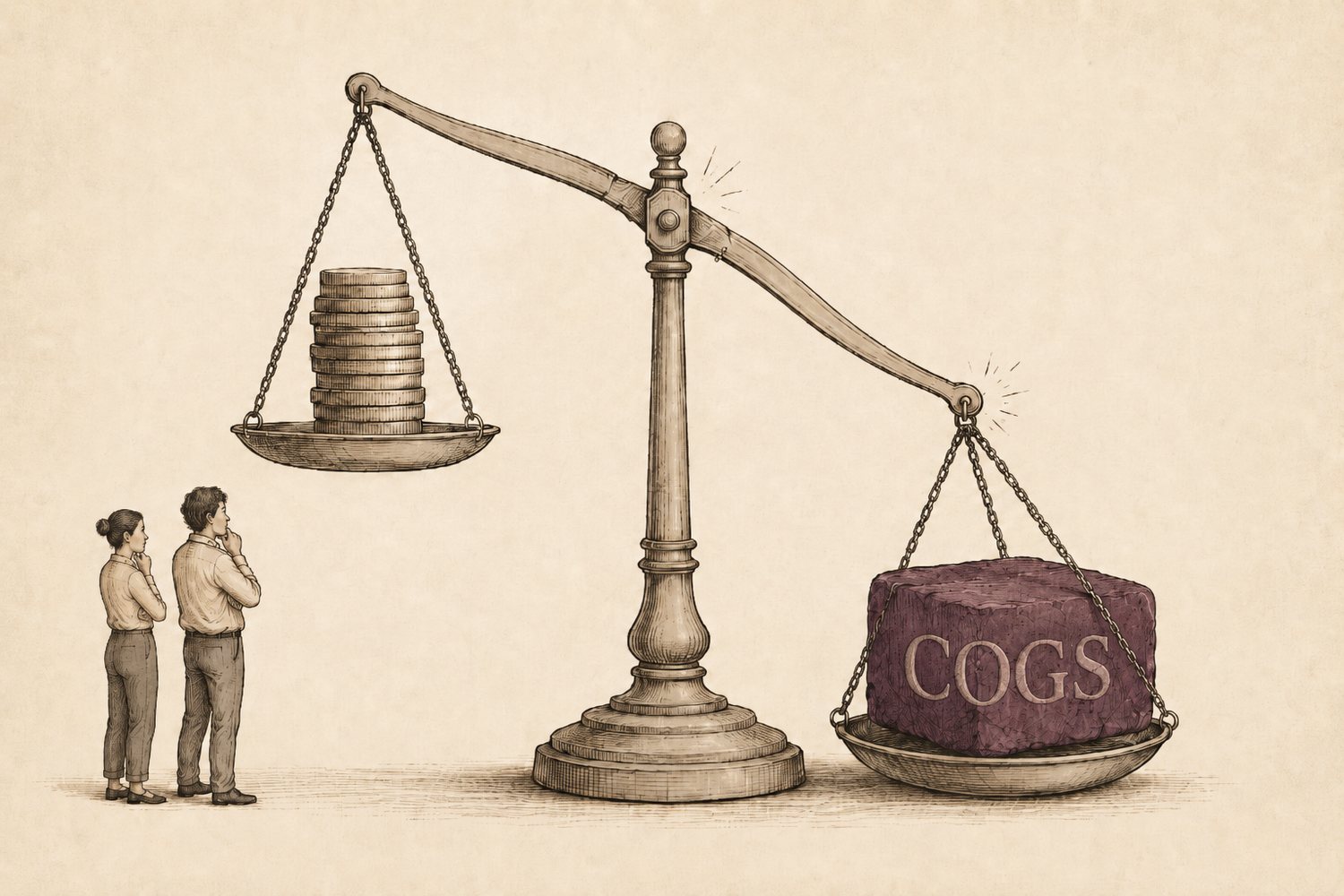
Here is the fact that explains almost everything about how AI software now charges you, and it's an accounting fact, not a strategy one: for the entire history of SaaS, software had no cost of goods sold worth the name. You built the product once, and serving the millionth user cost about what serving the thousandth did — a rounding error in bandwidth and storage. Gross margins of 80% were normal because the marginal cost of delivery was essentially zero. AI broke that. Every feature now calls a model, every call costs real money, and that cost scales with use. Software has acquired a cost of goods sold for the first time — and the credit meter is simply what COGS looks like once it lands on the invoice.
I read 52 AI products’ pricing pages for the AI Credit Index expecting to write about tactics — clever metering, hidden top-ups, the stealth increases that never touch the sticker price. All of that is real. But the deeper story underneath the whole migration is duller and more important than any tactic: the unit economics of software changed, and pricing is doing what pricing always eventually does — catching up to cost.
The margin that’s quietly compressing
Picture the old SaaS P&L. Revenue, then a thin slice of cost of revenue — hosting, support, a little overhead — and then a fat gross margin, 75 to 85 cents on the dollar, flowing down to fund sales and R&D. The marginal customer was almost pure margin. That single fact is what made flat per-seat pricing work: you could promise “unlimited” anything, because the heaviest user cost you almost the same as the lightest.
Now drop AI into that P&L. A power user hammering an AI feature is no longer near-free to serve — they’re calling expensive models hundreds of times a day, and each call is metered by your provider. Cost of revenue thickens. Gross margin on heavy users compresses, sometimes dramatically. The flat price that was a comfortable bet against near-zero marginal cost becomes a losing bet against a real and rising one — and the vendor loses it precisely on their best, most engaged customers.
This is the engine under the entire Index. When you see a product bolt a meter onto seats, harden a soft allowance into a hard ceiling, or re-base its credits to cost more, the proximate cause is almost always the same: compute cost, passing through. It’s the single force that explains the whole migration — and it’s why the migration runs one direction only. You don’t drift back toward flat pricing once your COGS is real.
”Unlimited” was a balance-sheet decision
Read it this way and the marketing language decodes itself. “Unlimited*” was never a generosity; it was a calculated subsidy, affordable only while the marginal cost it waved away was trivial. The asterisk is where the cost lives. As inference cost became material, the subsidy got expensive, and one by one the unlimited claims either sprouted fair-use fine print or quietly became hard ceilings. (That decode is its own piece: the asterisk is the business model.)
The same lens explains the shape of the price increases. Vendors don’t raise prices uniformly; they raise them on consumption, because that’s where their cost actually is. The buyer with a steady, light workload often sees no change. The buyer running heavy automation sees their effective rate climb — through overage, through re-based credit burn rates, through stripped-out unlimited tiers. That’s not (only) opportunism. It’s cost-following pricing: the customers who cost the most to serve are the ones being asked to pay more. Uncomfortable, but economically coherent.
What this means if you sit on the buy side
If you run a finance function, three things follow, and none of them are optional.
Move AI tools out of the “fixed subscription” mental bucket. A flat seat contract is a fixed cost: same number every month, easy to forecast, set-and-forget. A credit-metered AI tool is closer to a utility — it scales with usage, spikes in your busy periods, and can be re-based by the vendor without the headline moving. Budget the subscription floor as fixed and the credits-plus-overage on top as a genuine variable line, forecast against real usage. Teams that booked these as fixed SaaS are the ones getting surprised at quarter-end.
Re-underwrite the spend you already approved. A static dollar price is not a static cost — the credit burn rate behind it can move while the contract looks unchanged. The discipline is to track output per dollar each quarter (how much real work the plan’s credits buy now versus before), not just to confirm the invoice matches the order form. The order form can be right while the price has doubled.
If your own product embeds AI, your gross margin is now a pricing input, not an afterthought. The CFO’s job moves upstream into the pricing decision, because the wrong meter on the wrong feature can sell revenue at a negative margin. You need a real cost-of-goods model per feature and per user segment before you set the price — exactly the value-and-cost discipline Jean-Manuel Izaret and I got into on the podcast: a price is a signal about value, but it has to clear cost first, and for the first time in software, clearing cost is not automatic.
The rules of thumb need an asterisk of their own
A generation of SaaS heuristics was built on the near-zero-marginal-cost assumption, and the most basic one quietly breaks when COGS shows up. “Gross margin should be 80%+” assumed delivery was almost free — and it isn’t, once a meaningful share of revenue rides on heavy inference. For AI-heavy software, a structurally lower gross margin isn’t a sign of a badly run company; it’s the new cost structure of the category. Even composite yardsticks mislead when you read their margin half against a classic-SaaS bar: a Rule-of-40 score isn’t wrong, but the 40 you’d accept from a 85%-margin business and a 55%-margin one mean different things. Benchmarking an AI product against classic-SaaS margins is comparing two different businesses that happen to share a delivery mechanism.
This is the genuinely interesting part for finance people, and the reason I think this story matters more than the tactics: AI is turning software back into a business with a cost of goods sold — more like a manufacturer or a utility than like the zero-marginal-cost machine SaaS was for two decades. That changes what a healthy P&L looks like, what pricing has to accomplish, and how you budget for the tools your own team runs on.
The seat-to-credit shift isn’t a fad you can wait out, and it isn’t, at root, a trick — though it’s often dressed as one. It’s cost surfacing in price, the most ordinary thing in economics, happening to an industry that got to skip it for twenty years. The whole picture, vendor by vendor and archived to the date, is the AI Credit Index — built so the cost showing up in your software budget is something you can see coming, and plan for.
Related questions
- Why are AI software gross margins lower than traditional SaaS?
- Because AI software has a real, variable cost of delivery that classic SaaS didn't. Once a traditional SaaS product was built, serving one more user cost almost nothing — gross margins sat at 75–85%. Every AI feature, by contrast, calls a model, and every call costs the vendor money in compute. That cost scales with usage and lands in cost of goods sold, so the more a customer uses the product, the thinner the margin on that customer. The credit meter exists to keep that variable cost from eating the vendor alive on its heaviest users.
- Should I budget AI software as a fixed or a variable cost?
- Increasingly as variable. A flat per-seat SaaS contract is a fixed cost — predictable, forecastable, the same every month. A credit-metered AI tool behaves more like a utility bill: it scales with how much your team uses it, spikes in busy periods, and can be re-based by the vendor without the headline price changing. Treat the subscription floor as fixed and the credits-and-overage on top as a variable line you forecast against actual usage, not a number you set once and forget.
- What is cost of goods sold for an AI product?
- Primarily inference compute — the cost of running the AI models that power each feature, paid per call to a model provider or per GPU-hour on owned infrastructure. It also includes data and retrieval costs, and any third-party API the product calls to do its work. Unlike traditional software hosting (a thin, largely fixed cost), AI COGS is substantial and scales directly with usage, which is why it shows up in pricing as a meter rather than disappearing into overhead.