“Unlimited*” — the asterisk is the business model
What the word means on an AI pricing page, what the small print takes back, and why almost no AI plan is actually unlimited.
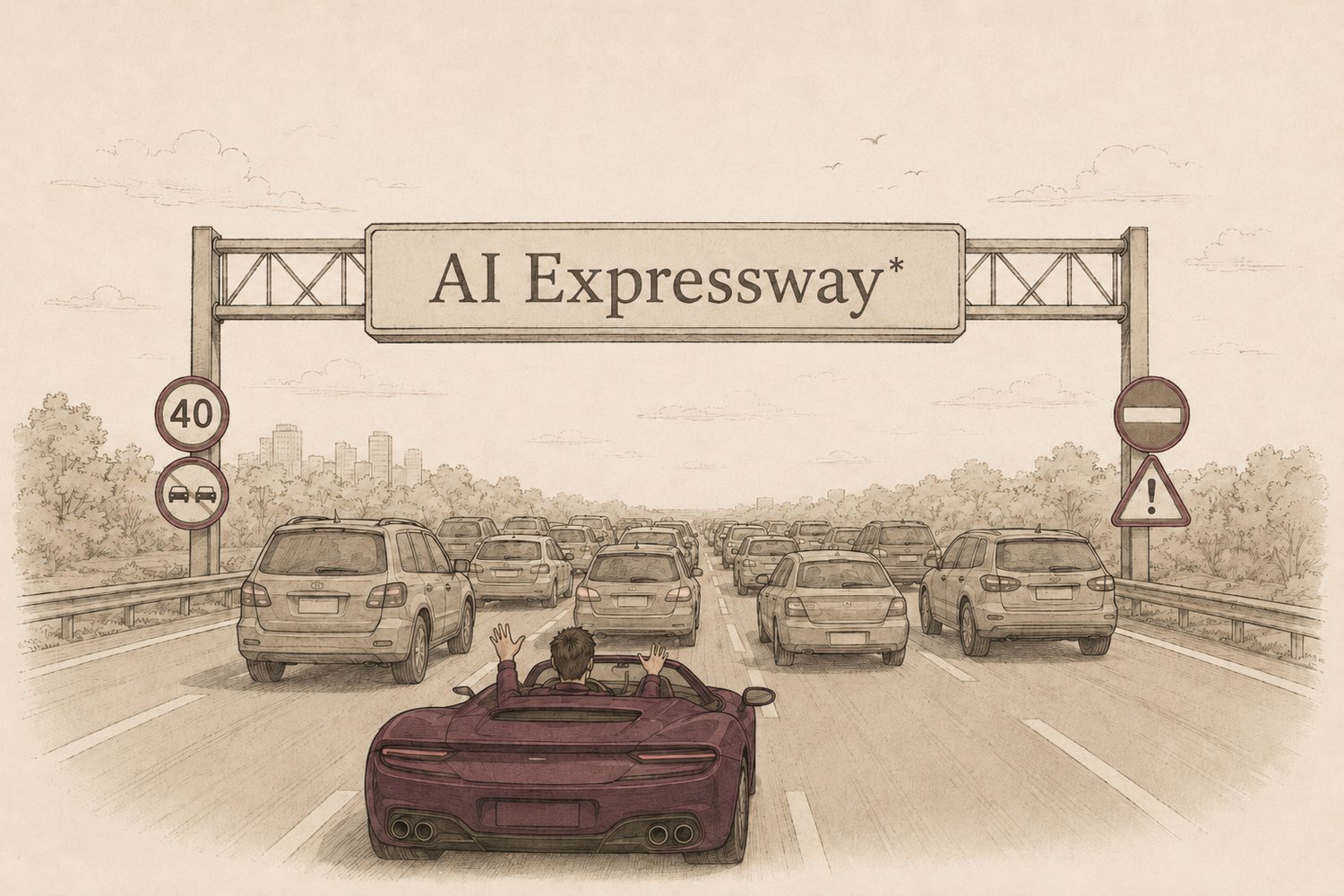
"Unlimited" is the most expensive word on an AI pricing page, and the asterisk next to it is doing all the work. I read the public pricing of 52 AI products for the AI Credit Index, and the single most reliable pattern wasn't a number — it was a typographic tell. Wherever a plan promised unlimited anything, a small mark followed it to a line of text that quietly took a good part of the promise back. Once you learn to read the asterisk, the word stops being a feature and starts being the business model.
The headline truth: genuine, no-ceiling unlimited is the rare exception in AI software, not the norm. Two-thirds of the panel — 35 of 52 products — sits at a hard allotment: a fixed monthly credit bucket, a real wall when it empties, a pack to buy to keep going. That is the literal opposite of unlimited, and it’s where most of the market has landed. (Why everything converged there is the pillar essay.) So when “unlimited” does appear, the interesting question is never whether it’s qualified. It’s how.
The four asterisks
Every “unlimited” claim I found resolved to one of four qualifiers — sometimes more than one.
The fair-use asterisk. The most common, and the slipperiest. “Unlimited usage, subject to our reasonable-use policy.” This converts a published ceiling into the vendor’s discretion: there’s no number, just a reserved right to throttle, downgrade, or suspend accounts that consume more than the vendor likes. It’s unlimited until your usage becomes expensive enough to be noticed — at which point the policy, not the price, decides what happens to you. Functionally, it’s an undisclosed cap — and it’s how Notion’s AI add-on ran for years: “unlimited” use under a reasonable-use policy.
The slow-lane asterisk. “Unlimited generations” — in the slow queue. Fast or priority capacity stays metered; the unlimited part is the degraded lane. Cursor ran a version of this in early 2025: its $20 plan paired a few hundred fast requests with unlimited slow ones, so the unlimited was real but routed through the throttle. When the economics tightened, the slow-lane unlimited was the first thing stripped from the best models. The word stayed; the lane it referred to narrowed.
The select-models asterisk. “Unlimited” on the cheap or older models; metered the moment you touch the frontier ones everybody actually wants. The promise is technically kept and economically hollow — the unlimited applies precisely where the vendor’s cost is low, and the meter switches on exactly where it’s high. Magnific’s upper tiers do this literally: “Unlimited*” on most models, credits the moment you call a premium one.
The until-we-change-it asterisk. The most honest and the most alarming, because it’s printed plainly — and the same Magnific stacks it on top of the last one. In its FAQ it reserves the right to “update credit costs at any time, without prior notice,” so even the part it calls unlimited is revocable at will. Unlimited is a snapshot taken at the vendor’s convenience — a marketing state, not a contractual one.
The walk-back is the proof
If “unlimited” were a stable, profitable promise, vendors would keep it. Watch what they actually do when the subsidy gets expensive, and you can see the asterisk being cashed in.
Runway is the clean case. At the start of 2025 its top tier was branded “Unlimited” — credit-free generation in a relaxed “Explore” mode. Then reality intruded: users noticed the $95 Unlimited plan carried the same credit pool as the cheaper Pro tier, and that “heavy” accounts were being throttled or suspended under — you guessed it — the fair-use clause. Runway retired the Unlimited plan and migrated everyone to a new “Max” tier: a clean, finite 9,500-credit allotment with one month of rollover. The company didn’t sneak away from unlimited. It rebranded toward honesty — replacing a soft, deniable “unlimited” with a hard, legible ceiling. That’s the whole arc of the category in one product: the asterisk gets too expensive to honor, so the word goes and the number arrives.
It rhymes with what happened across the panel. “Unlimited” claims either grew fine print or became hard caps, because the thing they were waving away — the real cost of each AI action — stopped being negligible. That cost is the subject of its own essay: AI pricing is just COGS finally showing up. Unlimited was affordable when delivery was nearly free. It isn’t free anymore, so unlimited isn’t unlimited anymore.
How to price the small print
You can’t make a vendor drop the asterisk. You can refuse to pay for the word and insist on pricing the conditions instead.
- Read “unlimited” as “a lot, under conditions” — then find the conditions. They’re in the footnote, the fair-use policy, or the help docs, never the headline. If you can’t locate them, that absence is the answer.
- Translate the qualifier into a number for your workload. “Unlimited on standard models” is worthless if your team lives on the frontier model that’s metered. Ask what’s actually uncapped for the work you do, not in general.
- Treat a fair-use clause as an undisclosed cap and ask for the threshold. A vendor confident in its “unlimited” can tell you, in writing, the usage level at which the policy kicks in. Most won’t. The refusal is information.
- Assume the asterisk can move. “Unlimited*, credit costs subject to change” is a price that resets at the vendor’s discretion — so the live question isn’t today’s allowance, it’s how quietly they can re-base it tomorrow. Get change-notice terms if you can.
None of this means “unlimited” is always a lie. A genuine soft meter — usage that runs past the line without stopping or charging you — does exist; it’s just the rarest rung on the board. The point is that the word has stopped carrying information. The information moved to the asterisk, and the asterisk is where the business model now lives. The full set of claims and qualifiers, product by product and archived to the date I read them, is the AI Credit Index — so the next time a plan promises you everything, you can check the footnote against the field.
Related questions
- Is 'unlimited' AI software pricing actually unlimited?
- Almost never. Across the 52 products in the AI Credit Index, genuine no-ceiling usage is the rare exception — most plans that advertise 'unlimited' carry an asterisk that takes a meaningful part of it back: a fair-use clause, a slower or lower-quality lane once you pass a threshold, 'unlimited' only on the cheaper models, or a cap the vendor can enforce at its discretion. Two-thirds of the panel actually sits at a hard allotment — a fixed credit ceiling you hit and then pay to lift — which is the literal opposite of unlimited. When you see the word on an AI plan, assume it means 'a lot, under conditions,' and go read the conditions.
- What does the asterisk on 'unlimited' AI plans mean?
- It points to the qualifier that converts 'unlimited' into something bounded. The four common ones: fair-use or 'reasonable use' policy (the vendor can throttle or suspend accounts it deems excessive); a relaxed or slow mode (unlimited only in a degraded lane, with fast/priority capacity still metered); model restrictions (unlimited on older or cheaper models, metered on the frontier ones); and time or trial limits. The asterisk isn't fine-print housekeeping — it's where the actual pricing lives, because it's the lever the vendor can pull without changing the advertised plan.
- What is fair use in AI software pricing?
- A fair-use (or 'reasonable use') clause lets a vendor advertise unlimited usage while reserving the right to throttle, downgrade, or suspend accounts whose consumption it considers abnormal. It transfers the definition of 'too much' from a published number to the vendor's discretion, applied after the fact. Practically, it means an 'unlimited' plan is unlimited until your usage becomes expensive enough to notice — at which point the clause, not the headline, governs what happens. Treat a fair-use asterisk as an undisclosed cap.